
Discover your inner strength with Neuro Insight
Understanding Trauma and Adversity
The Developing Brain: Why Early Experiences Matter
Every brain develops from the bottom up. Before children can think clearly, solve problems or manage emotions, the lower parts of the brain must first learn that the world is safe.
This concept forms the foundation of the Neurosequential Model, developed by Dr Bruce D. Perry, which explains how the brain develops through predictable stages. Rather than developing all at once, the brain builds itself layer by layer—each stage providing the foundation for the next.
The Three Levels of the Brain
🧡 1. The Survival Brain (Brainstem)
The brainstem develops first, beginning before birth. Its primary role is survival.
It regulates:
- Heart rate
- Breathing
- Sleep
- Arousal
- Stress responses
- Fight, flight, freeze and shutdown
When this part of the brain feels unsafe, survival always takes priority over learning.
💙 2. The Emotional Brain (Limbic System)
As children grow, experiences shape the emotional brain.
This system helps children:
- Form secure relationships
- Feel connected
- Understand emotions
- Build trust
- Develop emotional regulation
- Experience curiosity and motivation
Children borrow the emotional regulation of the adults around them before they can regulate themselves.
💚 3. The Thinking Brain (Cortex)
The thinking brain develops gradually throughout childhood and adolescence.
This allows children to:
- Learn
- Reason
- Plan
- Reflect
- Solve problems
- Use language
- Control impulses
- Understand other people's perspectives
The thinking brain works best when the lower parts of the brain feel safe.
Regulation Before Reason
One of the most important principles of Dr Perry's work is that stress pushes us down the brain, while safety brings us back up.
When children experience fear or overwhelming stress, the brain naturally shifts away from thinking and towards survival.
This is why a distressed child often cannot simply "calm down", "think about it", or "make a better choice."
The brain is doing exactly what it evolved to do—keeping the child alive.
The sequence therefore becomes:
Regulate → Relate → Reason
Rather than beginning with consequences or explanations, effective support first helps the child feel safe, then connected, before expecting learning or problem-solving.
Trauma Changes Development
Childhood trauma is not simply something that happens to a child—it is something that shapes how the developing brain organises itself.
When stressful experiences are severe, prolonged or occur without supportive relationships, the brain begins adapting for survival rather than exploration and learning.
These adaptations are not signs of damage or weakness.
They are survival strategies that once helped the child cope.
Examples include:
- heightened alertness to danger
- emotional outbursts
- shutting down
- difficulty trusting adults
- sensory sensitivities
- poor concentration
- impulsive behaviour
- difficulty sleeping
- problems with emotional regulation
These behaviours often make perfect sense when viewed through the child's experiences.
The Power of Relationships
The encouraging news is that the brain remains capable of change throughout life.
The same brain that adapts to danger can also adapt to safety.
Supportive, predictable and emotionally available relationships help the nervous system gradually become less reactive and more regulated.
This is why healing rarely comes through punishment or persuasion alone.
Instead, it grows through thousands of repeated experiences of feeling:
- safe
- understood
- accepted
- connected
- successful
Over time these experiences help build stronger pathways for regulation, resilience and learning.
Evidence Base
The ideas on this page are primarily informed by the work of Dr Bruce D. Perry, creator of the Neurosequential Model, alongside contemporary research in developmental neuroscience, attachment and childhood adversity.
"The sequence matters: regulate first, then relate, then reason."
— Dr Bruce D. Perry.
Transform your life with Neuro Insight
Understanding Adversity
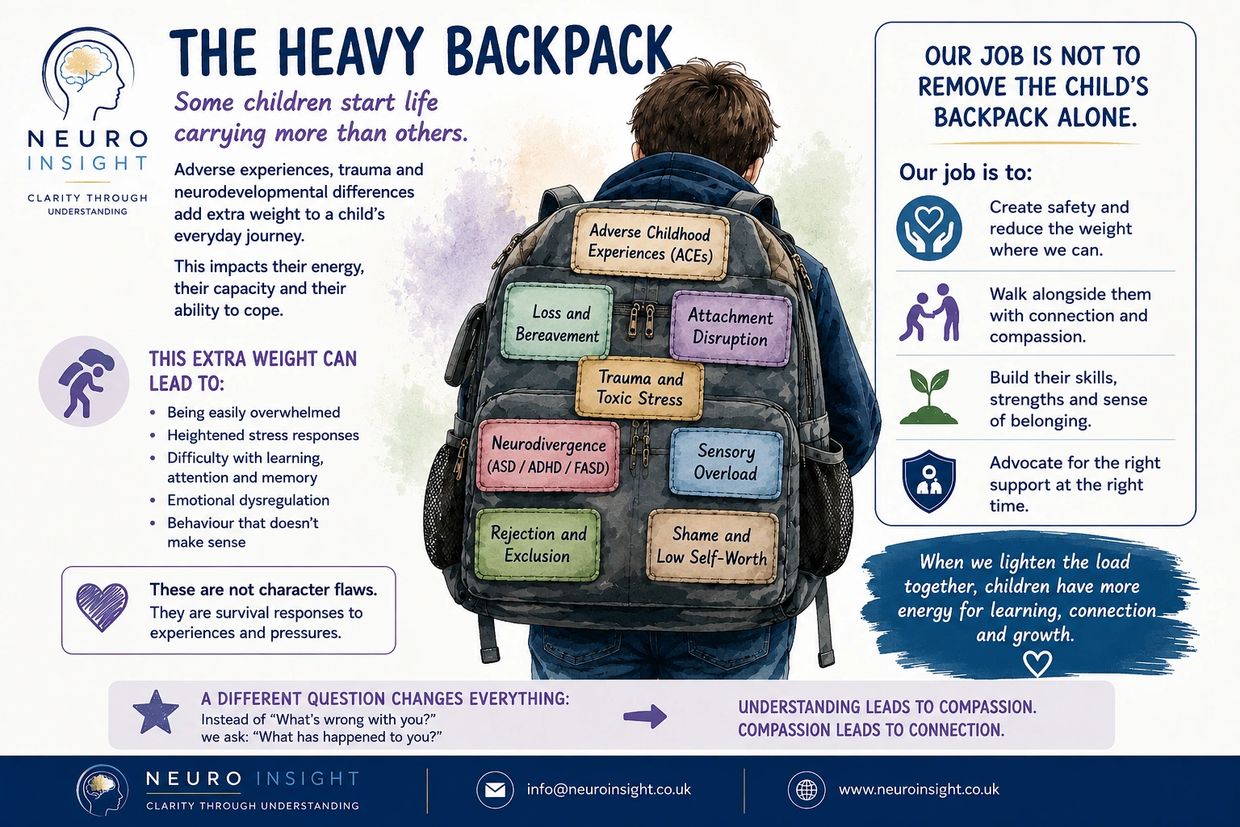
Not Every Child Carries the Same Backpack
Every child arrives in the world with enormous potential.
As they grow, every experience they have—positive and negative—goes into the "backpack" they carry through life.
Supportive relationships, encouragement, opportunities and love help fill that backpack with confidence and resilience.
Repeated adversity, however, can gradually fill it with fear, uncertainty and stress.
The backpack graphic above illustrates how experiences such as abuse, neglect, family conflict, bereavement, bullying and discrimination can accumulate over time. These experiences don't define a child, but they do influence how the developing brain interprets the world.
Where Did the ACEs Concept Come From?
The term Adverse Childhood Experiences (ACEs) comes from a landmark study conducted in the 1990s by Dr Vincent Felitti and Dr Robert Anda.
Working with over 17,000 adults, they discovered something remarkable.
Many of the most common causes of illness in adulthood—including heart disease, depression, substance misuse, obesity and suicide attempts—were strongly associated with adversity experienced during childhood.
Perhaps even more striking was the dose-response relationship.
The greater the number of adverse experiences a person had faced in childhood, the greater their likelihood of experiencing difficulties across physical health, mental health and social outcomes later in life.
The study transformed our understanding of health by demonstrating that childhood experiences become biologically embedded and can influence wellbeing across the lifespan.
Toxic Stress: When the Alarm System Never Switches Off
Stress itself is not harmful.
In fact, manageable/tolerable stress is a normal and healthy part of development. Learning something new, sitting an exam or trying a new activity all help children grow.
Problems arise when stress becomes severe, frequent or prolonged without the buffering effect of supportive relationships.
This is known as toxic stress.
Instead of returning to a calm baseline after a stressful event, the child's stress response remains activated for long periods.
The body continues releasing stress hormones such as cortisol and adrenaline, preparing for danger even when danger is no longer present.
Over time this can affect:
- Brain development
- Emotional regulation
- Learning and memory
- Attention and concentration
- Sleep
- Physical health
- Immune functioning
- Relationships
The child is not choosing to stay in survival mode—their nervous system has learned that the world feels unsafe.
The Bear Isn't the Problem
Paediatrician Dr Nadine Burke Harris uses a simple analogy to explain how our stress response system works.
Imagine you encounter a bear while walking in the woods.
Your brain immediately activates its survival system.
- Your heart beats faster.
- Your breathing quickens.
- Blood flows to your muscles.
- You become stronger, faster and more alert.
This response is life-saving. It is exactly what your body was designed to do.
Once the bear has gone, your nervous system settles. Your heart rate slows, stress hormones reduce, and your brain returns to a state where you can think, learn, connect and recover.
The problem begins when the bear doesn't go away.
For some children, the "bear" isn't a wild animal—it is everyday life.
It may be a parent whose mood is unpredictable because of alcohol or substance misuse. It may be frequent shouting, conflict or high levels of expressed emotion at home. It may be ongoing bullying, domestic abuse, neglect, repeated rejection or living in an environment that never feels completely safe.
Our stress response system was designed to deal with short periods of danger, not to remain switched on for weeks, months or years. When the nervous system is repeatedly activated without enough opportunities to recover, it experiences what we call toxic stress. Over time, this places a significant burden on the developing brain and body.
Eventually, the brain adapts to survive in this world. It becomes quicker to detect possible threats, even when they are uncertain or ambiguous.
A teacher raising their voice.
A disagreement with a friend.
Being asked to tidy a bedroom.
A crowded classroom.
Someone standing too close.
These situations may not be dangerous, but to a nervous system shaped by chronic adversity they can feel as though another bear has appeared.
The problem isn't the stress response itself—it's that the brain has learned that the bear is always nearby.
The encouraging news is that the brain is remarkably adaptable. Through safe, predictable relationships, supportive environments and repeated experiences of regulation, the nervous system can gradually learn that it no longer has to stay on constant alert.
ACEs Increase Risk—They Do Not Determine Destiny
One of the biggest misconceptions about ACEs is that they predict a child's future.
They do not.
The ACE study identified patterns across large populations, not fixed outcomes for individuals.
Many people who experience multiple adverse childhood experiences go on to lead healthy, fulfilling lives.
Likewise, some people with relatively few ACEs still experience significant difficulties.
What makes the difference?
The answer often lies in protective experiences.
The Most Powerful Protective Factor
Research consistently shows that safe, stable and nurturing relationships are the single greatest buffer against the effects of adversity.
One trusted adult cannot erase difficult experiences, but they can profoundly change how the child's brain learns to respond to them.
Every experience of being:
- comforted
- understood
- accepted
- protected
- listened to
- encouraged
helps teach the nervous system that the world can also be safe.
Healing happens through thousands of these small moments.
The goal is not to erase the past.
It is to build enough experiences of safety that the brain no longer expects danger around every corner.
From "What's Wrong With You?" to "What Happened to You?"
Understanding ACEs shifts the focus away from blame and towards curiosity.
Instead of asking,
"Why is this child behaving like this?"
we begin asking,
"What experiences might have shaped the way this child's nervous system has learned to respond?"
That small change in perspective transforms behaviour from something to control into something to understand.
And when behaviour begins to make sense, compassionate and effective support becomes possible.
Further Reading
This section draws on the work of:
- Dr Vincent Felitti & Dr Robert Anda – The original Adverse Childhood Experiences (ACE) Study
- Dr Nadine Burke Harris – The Deepest Well and her work translating ACE research into clinical practice
- Dr Bruce D. Perry – Neurodevelopment, toxic stress and the Neurosequential Model
- Center on the Developing Child, Harvard University – Research on toxic stress, resilience and early brain development.
Interested in further training?
Take a look at our Training service for bespoke and online training options.