
Healing Through Connection
The Regulation Ladder
Regulation Before Behaviour
One of the most important lessons from developmental neuroscience is that behaviour is a reflection of the state of the nervous system.
When children feel safe, connected and regulated, they can think clearly, learn, solve problems and manage their emotions.
When they feel overwhelmed, frightened or overloaded, the brain naturally shifts into survival mode. At these times, reasoning, consequences and rewards become far less effective because the thinking brain is temporarily offline.
This is why the first question should not be:
"How do I stop this behaviour?"
Instead ask:
"What does this child's nervous system need right now?"
The Regulation Ladder above illustrates this principle. Our goal is not to keep children permanently at the top of the ladder, but to help them recover more quickly whenever they slip down.
Sensory Regulation: Filling the Regulation Bucket
(Based on the Neurosequential Model of Dr Bruce D. Perry)
One of the simplest and most powerful ways to support an overwhelmed nervous system is through regular, predictable sensory regulation.
Dr Bruce Perry describes regulation as something that works through repetition rather than intensity.
Rather than waiting until a child is dysregulated, we help the brain stay regulated by providing small doses of calming sensory experiences throughout the day.
A useful guide is:
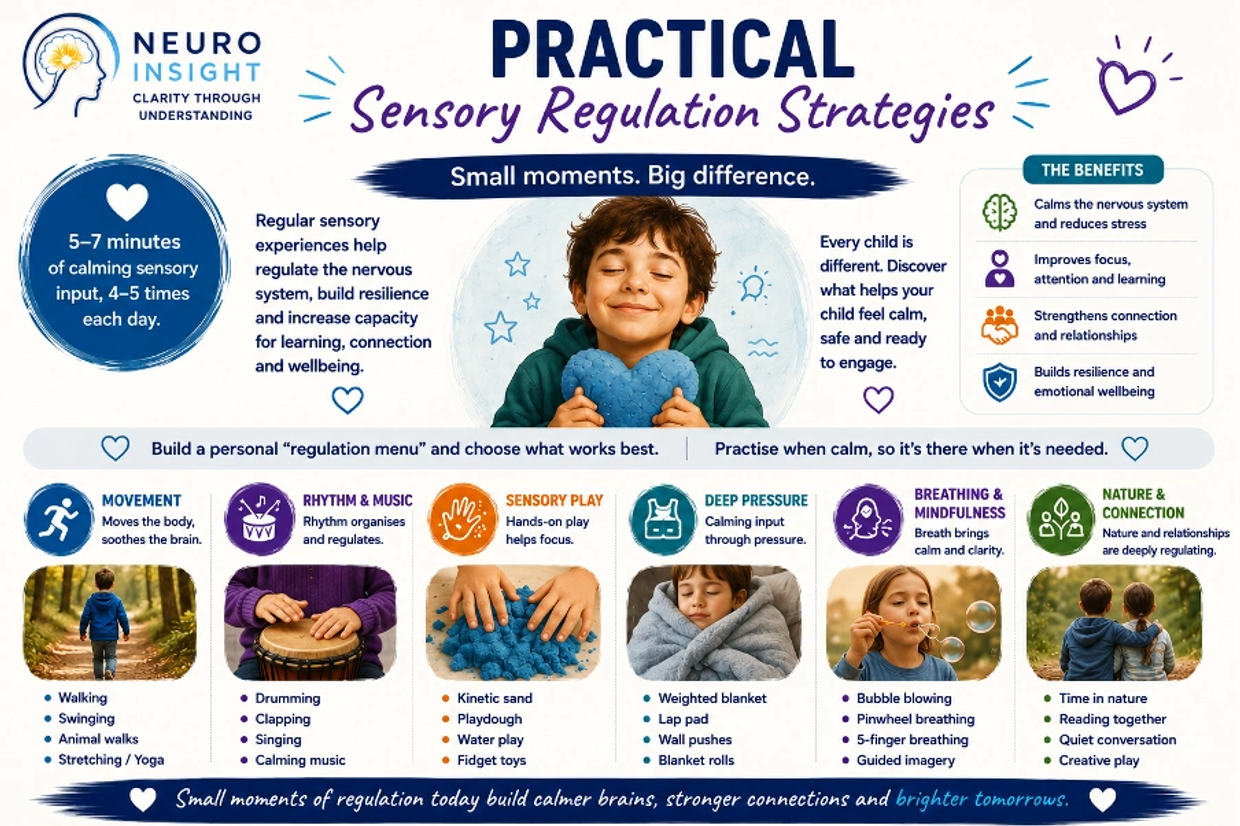
5–7 minutes of calming sensory input, 4–5 times each day.
These "sensory snacks" help lower baseline stress, making it less likely that children become overwhelmed later.
Calming sensory activities might include:
- Walking
- Swinging
- Rocking
- Slow rhythmic movement
- Listening to calming music
- Drumming or rhythm
- Deep pressure (where appropriate)
- Weighted blankets or lap pads
- Stretching or yoga
- Breathing exercises
- Bubble blowing
- Drawing or colouring
- Playing with kinetic sand or putty
- Time in nature
- Quiet reading together
The key is that the activity should be:
✔predictable
✔ repetitive
✔ rhythmic
✔ enjoyable
✔ calming for that individual child
Different children regulate in different ways. What soothes one child may overwhelm another.
The aim is not simply to calm behaviour—it is to strengthen the child's capacity to regulate their own nervous system over time.
Our Services
We offer individual and couples therapy, group therapy, and online therapy sessions. Our therapists are experienced and licensed professionals who are committed to helping you achieve your goals.
Empowering Your Mental Health
Low Demand Parenting
Supporting Without Increasing Stress
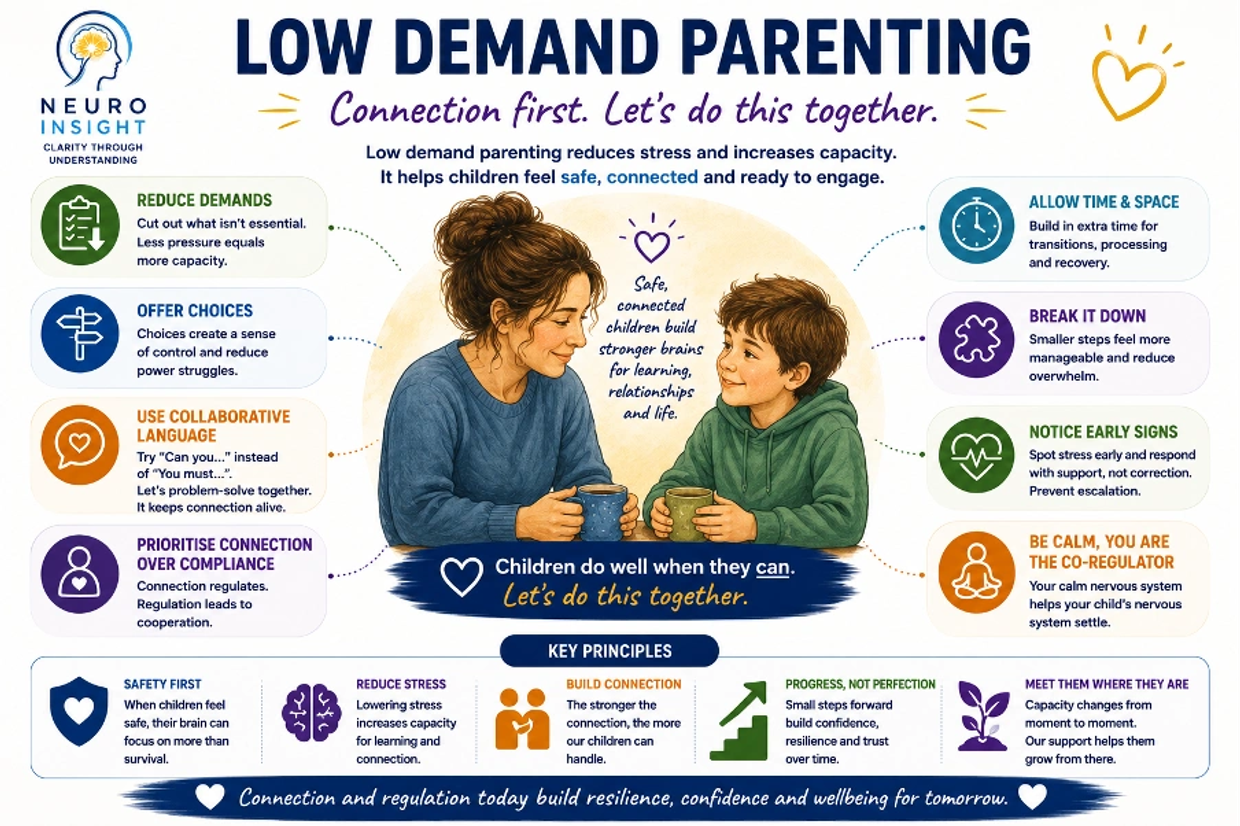
Many neurodivergent and trauma-experienced children live with nervous systems that are already working incredibly hard.
Constant demands—even ordinary everyday ones—can quickly overload their capacity.
Low-demand parenting is not about lowering expectations forever.
It is about reducing unnecessary stress so that children have enough capacity for the things that matter most.
Instead of asking:
"Why won't they do it?"
we ask:
"Do they currently have the capacity to do it?"
Low-demand parenting often includes:
- reducing unnecessary instructions
- offering choices rather than commands
- using collaborative language
- prioritising connection over compliance
- allowing recovery time after overwhelming experiences
- breaking tasks into smaller steps
- accepting that capacity changes from day to day
- recognising early signs of overload before crisis occurs
Children generally do well when they can.
Reducing demands often increases success—not because expectations disappear, but because children finally have enough capacity to meet them.
Low-demand parenting is especially helpful for many autistic children, children with PDA profiles, ADHD, developmental trauma and those living with chronic anxiety.
Our Services
We offer training, assessment, parental consultations and individual therapy
Discover your inner strength with Neuro Insight
Low Demand Teaching
Supporting Learning Through Regulation
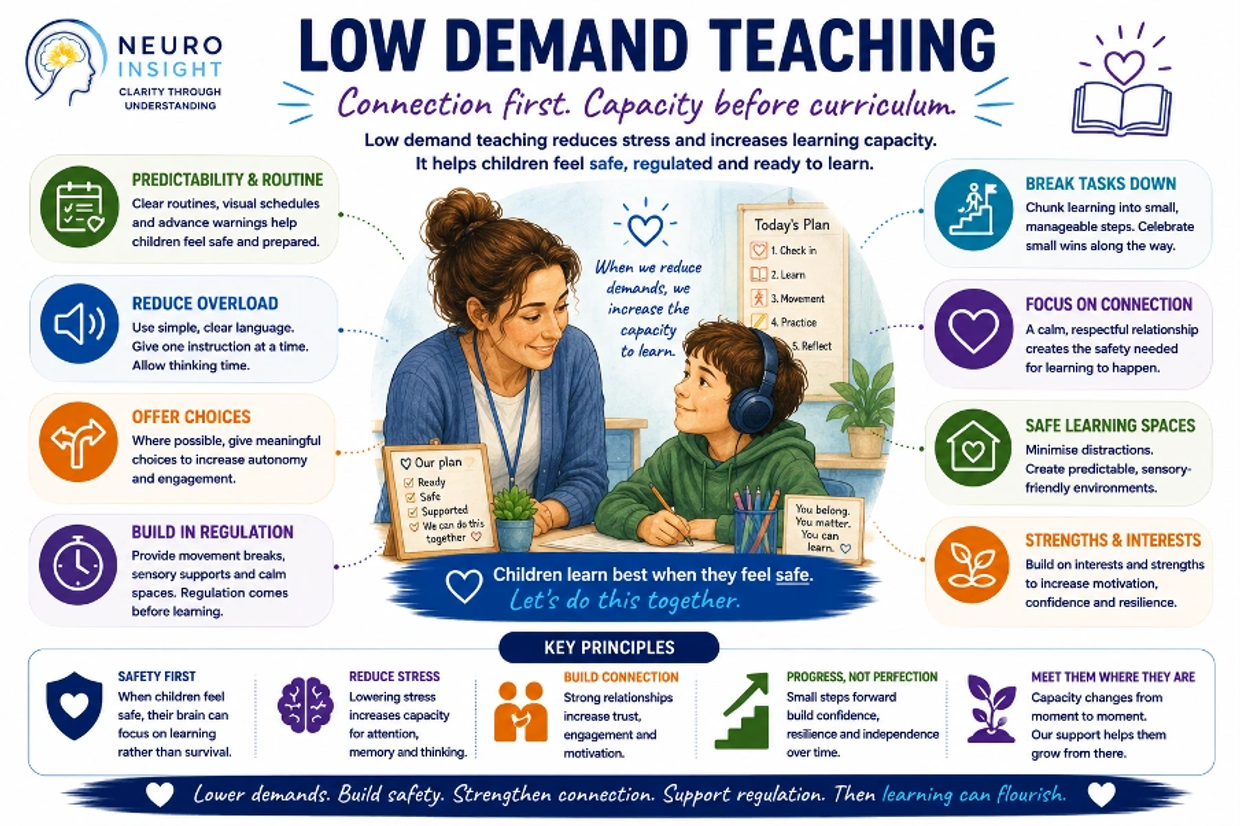
The same principles apply within schools.
Children cannot access learning when their nervous system is focused on survival.
Low-demand teaching aims to reduce unnecessary cognitive and emotional load while maintaining meaningful learning opportunities.
This might include:
- providing visual schedules and routines
- warning before transitions
- reducing verbal overload
- offering processing time
- giving choices where possible
- providing movement breaks
- allowing alternative ways of completing work
- reducing sensory distractions
- focusing on one instruction at a time
- creating safe regulation spaces
- recognising that behaviour often communicates stress rather than defiance
Importantly, reducing demands does not mean reducing aspirations.
Instead, it creates the conditions in which learning becomes possible.
Children are far more likely to succeed when they feel safe, understood and supported.
Progress Isn't Measured by Perfect Behaviour
Recovery is rarely linear.
Children will continue to move up and down the Regulation Ladder.
Success is not measured by never becoming dysregulated.
Instead, we look for signs that children are:
- recovering more quickly
- asking for help earlier
- recognising their emotions
- using regulation strategies independently
- trusting adults more readily
- spending longer in the reflective state
These are often the earliest—and most meaningful—signs that the nervous system is healing.
Take the First Step Today
Don't let mental health challenges hold you back from achieving your goals. Contact us today to schedule your initial consultation with our licensed psychologists.
Healing Through Connection
Practical Regulation
20 Five-Minute Regulation Activities
Small moments. Big difference.
Children don't learn regulation from one big intervention. They develop it through hundreds of small experiences of feeling calm, safe and connected.
Based on the principles of Dr Bruce D. Perry's Neurosequential Model, aim to provide 5–7 minutes of calming sensory input 4–5 times each day, rather than waiting until a child becomes overwhelmed.
The best regulation activity is the one the child enjoys and will willingly return to.
🚶 Movement & Rhythm
These activities help organise the lower parts of the brain through predictable, repetitive movement.
Try:
✅ Walking together
✅ Slow cycling
✅ Gentle swinging
✅ Rocking chair
✅ Trampoline (steady bouncing rather than frantic jumping)
✅ Animal walks
✅ Dancing to calm music
✅ Yoga or stretching
Best for:
- Restlessness
- Anxiety
- Hyperactivity
- Emotional build-up
🥁 Rhythm & Music
Rhythm is one of the most effective ways of calming the nervous system.
Try:
✅ Drumming
✅ Clapping games
✅ Playing percussion instruments
✅ Listening to calming music
✅ Singing together
✅ Nursery rhymes
✅ Counting or chanting
Why it works
The brain naturally responds to predictable rhythm, helping organise stress systems and reduce arousal.
🌿 Sensory Regulation
Some children regulate best through sensory experiences.
Try:
✅ Kinetic sand
✅ Playdough
✅ Water play
✅ Rice or sensory bins
✅ Fidget toys
✅ Colouring
✅ Lego
✅ Simple puzzles
Remember:
Different children seek different sensory experiences.
Observe what genuinely helps your child feel calmer—not simply busier.
🧸 Deep Pressure & Proprioception
Deep pressure provides calming information to the nervous system.
Examples include:
✅ Weighted blanket (used safely)
✅ Weighted lap pad
✅ Bear hugs (only if welcomed)
✅ Cushion squeezes
✅ Rolling in a blanket ("burrito")
✅ Wall pushes
✅ Carrying books
✅ Pushing a loaded trolley
Many children describe deep pressure as helping their bodies feel more organised.
🌬️ Breathing & Mindfulness
Breathing works best when practised regularly—not just during meltdowns.
Try:
✅ Bubble blowing
✅ Pinwheel blowing
✅ Feather races
✅ Smell the flower, blow out the candle
✅ Five-finger breathing
✅ Guided imagery
These activities work particularly well when paired with movement or connection.
🌳 Nature
Natural environments are wonderfully regulating.
Ideas include:
✅ Short woodland walks
✅ Beach visits
✅ Gardening
✅ Watching clouds
✅ Collecting leaves
✅ Sitting quietly together outdoors
Nature provides gentle sensory input without overwhelming the nervous system.
❤️ Connection
Perhaps the most powerful regulator of all is another calm nervous system.
Try:
✅ Reading together
✅ Quiet conversation
✅ Shared colouring
✅ Playing a simple board game
✅ Baking
✅ Building Lego together
✅ Gentle humour
✅ Eye contact (where comfortable)
Connection is not another demand.
It is often the regulation strategy itself.
⭐ Build a Personal Regulation Menu
Every child's nervous system is unique.
Encourage children to discover:
What helps me when...
I feel...Things that help meWorried__________________Angry__________________Overwhelmed__________________Tired__________________Sad__________________Excited__________________
The goal is not to have one perfect strategy.
The goal is to build a personalised toolkit that grows over time.
Five Principles to Remember
🧠 Little and often beats long and occasionally.
❤️ Connection is usually more powerful than correction.
🎵 Rhythm regulates the brain.
🌱 Practise when calm—not only during crisis.
⭐ Every child's regulation menu will look different.
Neuro Insight Tip
Think of regulation like charging a mobile phone.
Waiting until the battery reaches 1% makes recovery much harder.
Small, regular "top-ups" throughout the day help children stay within their window of tolerance for longer, making learning, relationships and emotional regulation much easier to access.
Get Started Today
Take the first step towards a happier and healthier life. Contact us today to schedule your initial consultation with our licensed psychologists.