
Finding Clarity and Balance
Understanding Neurodiversity Different brains. Different strengths. Different support needs.
Neurodiversity describes the natural variation in how human brains develop, process information and experience the world.
Autism, ADHD and Foetal Alcohol Spectrum Disorder are distinct neurodevelopmental profiles. Each can influence how a person thinks, learns, communicates, regulates emotions, processes sensory information and manages everyday life.
Neurodivergence is not simply a collection of difficulties. Every profile includes its own combination of strengths, vulnerabilities, interests and ways of experiencing the world.
The aim of this resource is not to place people into boxes. It is to help families, educators and professionals understand why someone may need a different environment, pace or form of support.
Every Brain Has Its Own Mix
No two brains are configured in exactly the same way.
One person may be highly sensitive to noise but communicate confidently. Another may have strong verbal skills but struggle with planning, emotional regulation or unexpected change. Someone else may understand a concept well but find it difficult to apply that learning in a new setting.
The mixer analogy helps us think about these differences without describing the person as broken.
Each slider represents an aspect of functioning, such as:
- sensory processing
- social understanding
- communication and language
- executive functioning
- emotional regulation
- interests and attention
- motor coordination
When the individual’s needs and environment are poorly matched, the result may be overwhelm, anxiety, shutdown, impulsivity or behaviour that is difficult to understand.
Support is not about making every person produce the same sound. It is about understanding their individual mix and creating the conditions in which they can function, connect and flourish.
Healing Through Connection
Autism
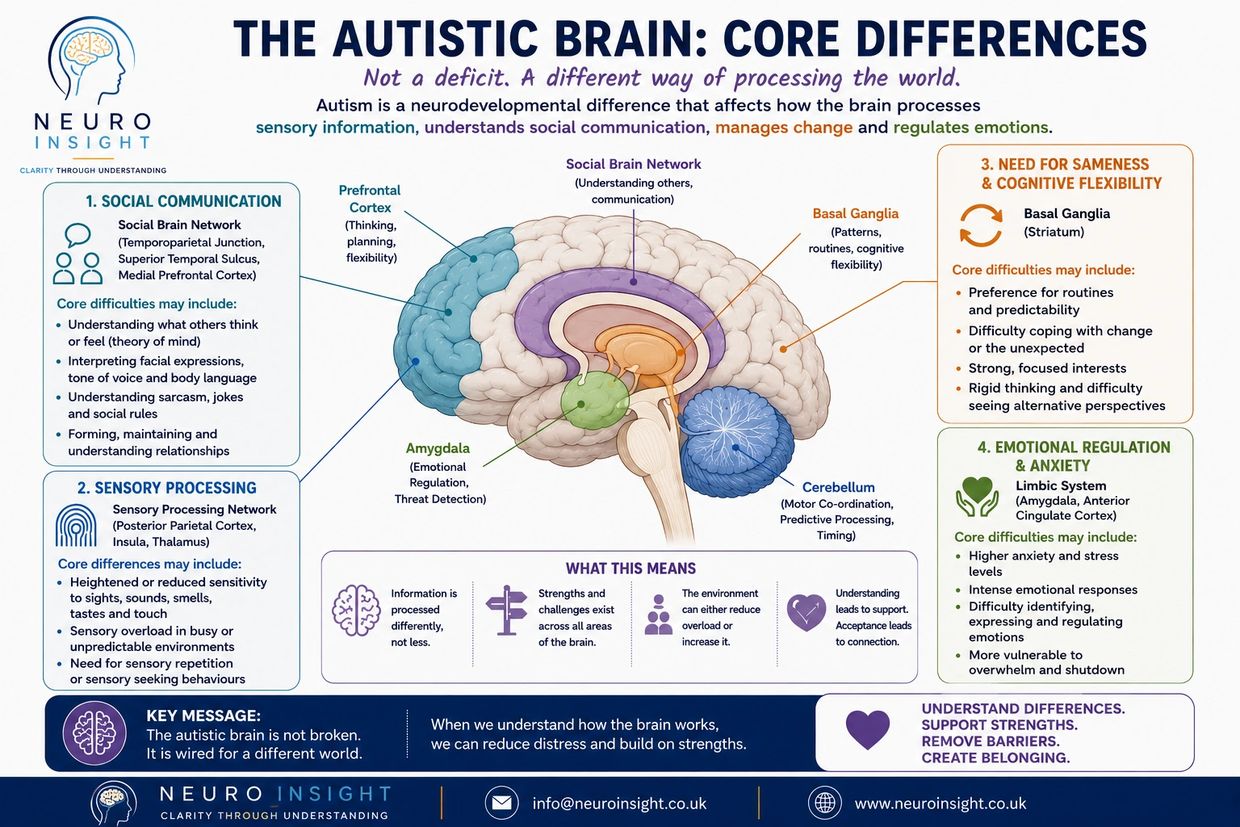
Autism is a lifelong neurodevelopmental difference affecting how a person processes sensory information, communicates, understands relationships, manages uncertainty and regulates emotions.Autistic people are highly diverse. There is no single autistic presentation, and support needs can vary significantly between individuals and across different environments.
Autism may affect:
- sensory processing and tolerance of busy environments
- understanding implied or non-verbal communication
- navigating social expectations
- coping with uncertainty or unexpected change
- emotional regulation
- flexibility of thinking
- the intensity and focus of interests
Autistic differences can also be associated with important strengths, including honesty, loyalty, detailed knowledge, pattern recognition, creativity, persistence and an ability to think outside conventional assumptions.A person may appear highly capable in one setting while using considerable energy to cope. This is why outward presentation does not always reflect the level of internal effort or support required.
What often helps
- predictability and advance notice of change
- clear and direct communication
- reduced sensory overload
- time to process information
- respect for individual communication styles
- access to interests and strengths
- environments where masking is not required for acceptance

Healing Through Connection
ADHD
ADHD is a lifelong neurodevelopmental difference affecting the regulation of attention, activity, motivation, impulses and emotions.
It is not simply an inability to concentrate. Many people with ADHD can focus intensely when something is interesting, urgent, novel or personally meaningful, but struggle to direct and sustain attention when a task offers little immediate stimulation or reward.
ADHD may affect:
- sustaining attention
- starting and completing tasks
- working memory
- planning and organisation
- impulse control
- awareness of time
- emotional regulation
- motivation and task persistence
- regulating activity and alertness
People with ADHD may also bring considerable strengths, including creativity, energy, spontaneity, humour, curiosity, rapid idea generation and the capacity for intense focus on areas of interest.
Difficulties are often interpreted as laziness, carelessness or lack of effort. In reality, many people with ADHD are expending significant effort while managing a nervous system that regulates attention and motivation differently.
What often helps
- tasks broken into manageable steps
- visual reminders and external structure
- movement and regular regulation breaks
- immediate and meaningful feedback
- reduced unnecessary distractions
- support with transitions and task initiation
- curiosity about what helps the person engage
- encouragement that recognises effort as well as outcome
Healing Through Connection
FASD
Foetal Alcohol Spectrum Disorder, or FASD, is a lifelong neurodevelopmental condition caused by prenatal alcohol exposure.
FASD can affect multiple areas of brain development, including memory, learning, impulse control, emotional regulation, information processing and adaptive functioning.
The profile is often uneven. A person may speak fluently and appear socially confident while having significant difficulty remembering instructions, understanding consequences or managing everyday responsibilities.
FASD may affect:
- learning and retaining new information
- working memory
- planning and problem-solving
- understanding cause and effect
- transferring learning between situations
- impulse control and risk awareness
- emotional regulation
- processing speed
- time awareness
- independent living skills
These difficulties are brain-based. They are not caused by poor parenting, lack of effort or deliberate defiance.
People with FASD may also show warmth, humour, creativity, determination, strong practical abilities and a desire to connect with others.
What often helps
- consistent routines and expectations
- simple, concrete language
- visual prompts and repeated teaching
- one instruction at a time
- additional processing time
- supportive supervision
- practical rather than abstract learning
- calm relationships and reduced shame
- adapting expectations to developmental ability rather than chronological age
.png/:/rs=w:1240,cg:true,m)
Healing Through Connection
Understanding AuDHD
AuDHD is an informal term used to describe people who are both Autistic and have Attention-Deficit/Hyperactivity Disorder (ADHD). Although AuDHD is not an official diagnostic label in diagnostic manuals such as the DSM-5 or ICD-11, it has become widely used within the neurodivergent community and by many clinicians because it recognises a unique pattern of strengths and challenges that can arise when Autism and ADHD occur together.
Research consistently shows that neurodevelopmental conditions commonly co-occur (comorbidity). Around 50–70% of Autistic people show clinically significant ADHD traits, and many people diagnosed with ADHD also meet criteria for Autism. Rather than simply adding one condition to another, the interaction between the two can create a distinctive profile. For example, one part of the brain may seek routine, predictability and quiet, while another craves novelty, stimulation and movement. This can create an internal "push-me, pull-you" experience that leaves people feeling exhausted, misunderstood or unsure why they seem to want opposite things at the same time.
Understanding AuDHD isn't about placing people into another category—it is about recognising that neurodevelopment is complex. Appreciating how Autism and ADHD interact allows us to provide more personalised support, build on strengths, reduce unnecessary demands and create environments in which people can thrive.

Different Profiles, Shared Experiences
Did you know?
Neurodevelopmental conditions rarely occur in isolation. Many people have overlapping profiles including Autism, ADHD, Developmental Coordination Disorder (DCD), Developmental Language Disorder (DLD), dyslexia, dyscalculia, tic disorders and Foetal Alcohol Spectrum Disorder (FASD). Understanding the whole profile is often more helpful than focusing on a single diagnosis.
Autism, ADHD and FASD are different neurodevelopmental profiles, but some everyday experiences may overlap.
These can include:
- sensory overwhelm
- difficulty regulating emotions
- executive functioning challenges
- anxiety
- fatigue
- difficulties in education or employment
- social misunderstanding
- low self-esteem following repeated criticism
- behaviour that is misinterpreted by others
Similar behaviour does not necessarily mean the underlying cause is the same.
For example, a person may avoid a busy classroom because of sensory overload, difficulty sustaining attention, anxiety, slower information processing or a combination of these factors.
Understanding the reason behind the behaviour is essential because the most helpful response will depend on the individual.
Looking Beyond Labels
A diagnosis can provide validation, access to community and a clearer explanation of someone’s experiences. However, a diagnostic label alone does not tell us everything we need to know.
Two people with the same diagnosis may have very different:
- strengths
- sensory profiles
- communication styles
- cognitive abilities
- emotional needs
- developmental histories
- levels of independence
- support requirements
Good assessment therefore asks more than:
“Which diagnosis applies?”
It also asks:
“How does this person’s brain work?”
“What makes everyday life harder?”
“What supports help them function at their best?”
Creating the Right Environment
Neurodivergent people do not thrive simply by being encouraged to try harder.
They are more likely to flourish when environments are adjusted to reduce unnecessary barriers and make their strengths accessible.
Helpful changes may include:
- increasing predictability
- reducing sensory overload
- simplifying communication
- providing visual structure
- allowing additional processing time
- supporting regulation before expecting reasoning
- building from interests and strengths
- replacing judgement with curiosity
Small environmental changes can make a significant difference to learning, relationships, confidence and wellbeing.
The Key Message
Neurodivergence is not a failure to develop normally.
It is a different developmental pathway.
When we understand a person’s individual mix, we can move away from blame and towards support that is compassionate, practical and effective.
Different mixer settings. Different sound. The same right to be heard.