
Empowering Your Mental Health
When Trauma and Neurodivergence collide
Looking Beyond Labels
Children are often described using labels such as autistic, ADHD, traumatised, anxious or behavioural.
While diagnoses can be incredibly helpful, they don't always explain why a child behaves the way they do.
One of the biggest challenges for parents, teachers and professionals is that developmental trauma and neurodevelopmental differences often look remarkably similar on the surface.
Both can affect attention, emotional regulation, relationships, learning, sensory experiences and behaviour.
Yet the reasons behind these difficulties—and therefore the support that is most helpful—may be very different.
Understanding the difference helps us respond with greater curiosity, compassion and effectiveness.
Similar Behaviours, Different Reasons
Many behaviours commonly associated with neurodevelopmental conditions can also emerge following significant adversity.
For example:
- difficulty concentrating
- emotional outbursts
- shutdowns
- sensory overwhelm
- social withdrawal
- impulsivity
- anxiety
- sleep difficulties
- executive functioning challenges
Looking only at the behaviour can lead us to assume two children have the same needs.
Often, they do not.
Behaviour is the surface.
The underlying brain processes may be very different.
Trauma Changes How the Brain Responds to the World
Developmental trauma does not alter a child's genetic neurodevelopment, but it can profoundly affect how existing brain networks function.
When a child's nervous system repeatedly experiences danger, unpredictability or chronic stress, the brain becomes increasingly organised around detecting threat.
This can influence many of the same brain systems involved in:
- attention
- emotional regulation
- working memory
- planning
- social understanding
- sensory processing
As a result, trauma can sometimes mimic characteristics that resemble autism, ADHD or anxiety disorders.
Importantly, these adaptations are understandable survival responses—not deliberate behaviours.
Neurodivergence Begins with Brain Development
Neurodevelopmental differences such as autism, ADHD and Foetal Alcohol Spectrum Disorder arise through differences in how the brain develops and connects.
These differences are not caused by trauma.
They are present from early development, although they may become more noticeable as the demands of life increase.
Neurodivergent brains process information differently.
Many individuals experience differences in:
- sensory processing
- communication
- attention
- executive functioning
- motor coordination
- emotional regulation
- need for predictability
These are genuine neurodevelopmental differences—not behaviours chosen by the individual.
When Both Are Present
Perhaps the most important message is this:
Trauma and neurodivergence are not mutually exclusive.
In fact, they frequently occur together.
Neurodivergent children often experience:
- misunderstanding
- bullying
- repeated failure
- exclusion
- sensory overwhelm
- chronic stress
All of these experiences can increase the likelihood of developing trauma responses.
Similarly, children who have experienced early adversity may later be recognised as neurodivergent once they reach greater stability.
One does not exclude the other.
Understanding how they interact is often far more helpful than trying to decide which came first.
How Do We Tell the Difference?
There is no single test that separates trauma from neurodivergence.
Instead, clinicians look at the whole developmental story.
Questions include:
- Were differences present from infancy or early childhood?
- Did behaviours change following stressful or traumatic experiences?
- Are difficulties consistent across different environments?
- Do behaviours reduce when the child feels safe and regulated?
- Is there a family history of neurodevelopmental conditions?
- How does the child's sensory profile fit with their history?
- What happens when we reduce stress and increase support?
The answers often reveal a more complete picture than behaviour alone.
Curiosity Changes Everything
Instead of asking:
"Is this trauma or autism?"
we can ask:
"How is this child's brain making sense of the world?"
or
"How are trauma and neurodevelopment interacting?"
These questions move us away from blame and towards understanding.
Our Approach at Neuro Insight
At Neuro Insight, we believe assessment should never focus on a diagnosis in isolation.
We seek to understand:
- how the brain has developed
- how life experiences have shaped it
- where strengths already exist
- which systems need support
- what interventions are most likely to help
Whether difficulties arise from neurodevelopment, adversity—or both—the goal remains the same:
reduce stress, build safety, strengthen relationships and create environments where people can thrive.
Key Message
Trauma can change how a neurodivergent brain functions.
Neurodivergence can influence how trauma is experienced. Neurodivergence can amplify trauma
Neither tells the whole story on its own.
Understanding both allows us to move beyond labels and towards support that truly fits the individual.
Book an assessment
Take the first step towards a better mental health today. Book your appointment with us and start your journey towards understanding, healing and personal growth.
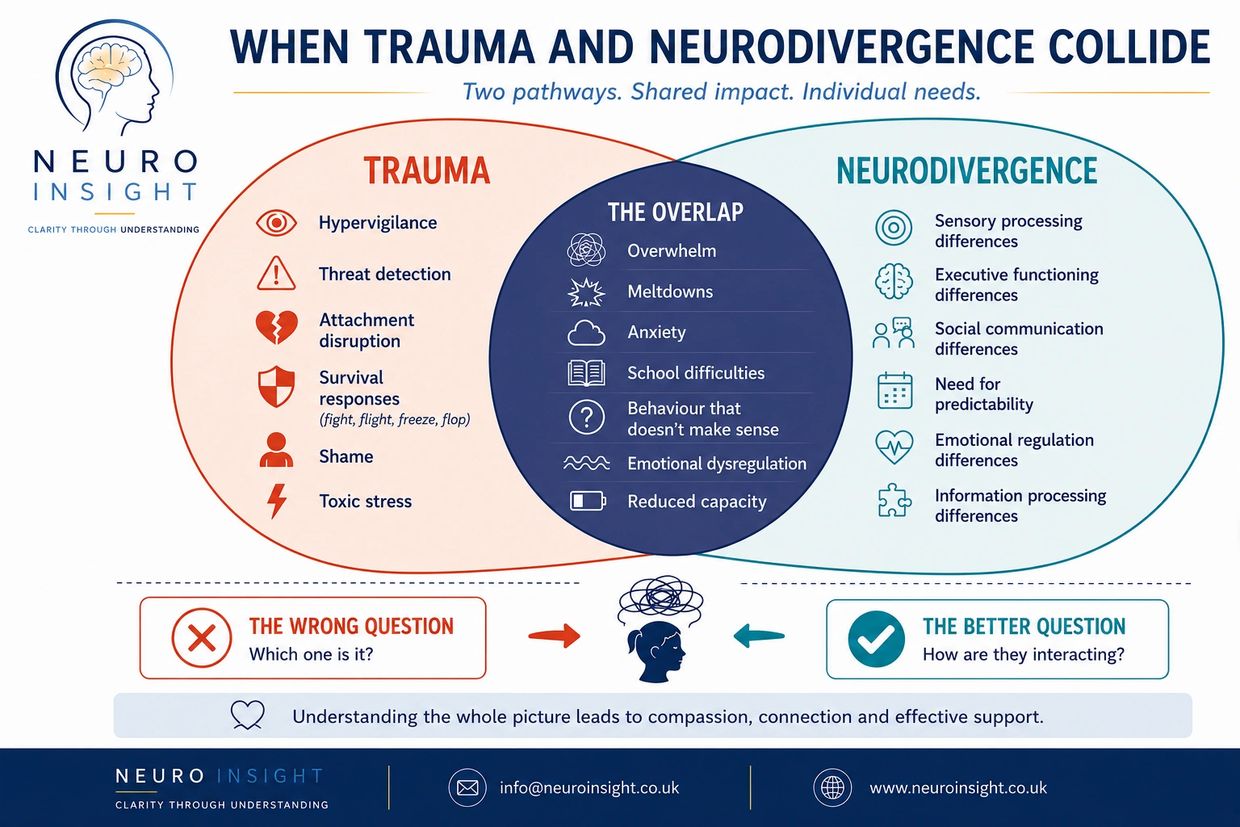
Finding Clarity and Balance
When both are true
One of the most common questions parents and professionals ask is:
"Is this trauma, or is it autism?"
"Is this ADHD, or is it anxiety?"
The difficulty is that many of the outward behaviours can look remarkably similar.
A child who appears distracted may be struggling because their brain is constantly scanning for danger.
Another child may struggle because their ADHD brain finds it difficult to regulate attention.
Both may look inattentive in the classroom—but for very different reasons.
Likewise, emotional outbursts, shutdowns, sensory overwhelm, social difficulties and executive functioning challenges can all arise through different developmental pathways.
Looking only at behaviour risks missing the bigger picture.
The better question is not "Which one is it?"
It is:
"How are these experiences interacting within this person's unique brain?"
Why Trauma Can Look Like Neurodivergence
Developmental trauma changes how the brain responds to the world.
Children who have lived through chronic stress often become highly skilled at detecting threat. Their nervous systems remain on alert, preparing for danger even when they are safe.
This heightened state of survival can affect many of the same brain systems involved in:
- attention
- emotional regulation
- working memory
- planning
- social understanding
- sensory processing
As a result, trauma may sometimes resemble characteristics commonly associated with autism or ADHD.
The behaviour may look similar.
The underlying cause may be very different.
Neurodivergence Has a Different Origin
Neurodevelopmental differences begin with differences in how the brain develops.
Conditions such as autism, ADHD and Foetal Alcohol Spectrum Disorder are present from early life, although they may become more noticeable as environmental demands increase.
These differences are not caused by trauma.
Instead, they reflect natural variation in how the brain processes information, regulates attention, communicates, responds to sensory input and manages executive functioning.
Understanding these neurological differences helps us build environments that fit the individual rather than expecting everyone to think, learn and regulate in the same way.
When Both Exist
Perhaps the most important message is this:
Trauma and neurodivergence frequently occur together.
Having one does not protect someone from experiencing the other.
In fact, research increasingly shows that neurodivergent children are more likely to experience adversity than their neurotypical peers.
Many experience:
- bullying and social exclusion
- repeated misunderstanding
- sensory overwhelm
- chronic feelings of failure
- school-based trauma
- restraint or exclusion
- family stress arising from unmet needs
Over time these experiences can become traumatic in themselves.
Equally, a child who has experienced early adversity may later be recognised as autistic, have ADHD or another neurodevelopmental difference once their nervous system becomes more regulated.
Neither explanation replaces the other.
Both contribute to the person's story.
The Double Impact
When trauma and neurodivergence coexist, each can amplify the effects of the other.
For example:
An autistic child may naturally experience sensory overload, while trauma adds hypervigilance that makes everyday environments feel even more threatening.
A young person with ADHD may already struggle with impulse control, while developmental trauma increases emotional reactivity and reduces their capacity to pause before acting.
Someone with Foetal Alcohol Spectrum Disorder may experience lifelong executive functioning differences, while early neglect makes it even harder to develop trust, emotional regulation and secure relationships.
This interaction is why support should never focus solely on diagnosis or solely on trauma.
Both need to be understood together.
Looking Beyond Behaviour
Behaviour is often the part we notice first.
It is also the least informative if viewed in isolation.
At Neuro Insight we encourage professionals to ask:
- When did these differences first appear?
- What has this person experienced?
- What happens when they feel genuinely safe?
- What strengths are already present?
- Which brain systems are working hardest?
- What support reduces stress rather than increasing it?
These questions move us beyond labels and towards understanding.
A Formulation, Not a Competition
It can be tempting to search for a single explanation.
However, brains are rarely that simple.
A comprehensive assessment considers:
- neurodevelopment
- attachment
- trauma history
- sensory processing
- cognition
- executive functioning
- relationships
- resilience
- protective factors
Rather than asking which explanation is correct, we build a formulation that explains how these different factors interact to shape the individual's everyday experience.
Understanding Leads to Better Support
Whether difficulties arise from trauma, neurodivergence or both, the principles of support remain remarkably similar.
Children thrive when we:
- reduce unnecessary stress
- increase predictability
- strengthen relationships
- adapt environments
- build on strengths
- support regulation before expecting reasoning
- remain curious rather than judgmental
When we understand the whole picture, behaviour begins to make sense.
And when behaviour makes sense, compassionate and effective support becomes possible..
Our Approach
We believe in a holistic approach to assessment, that the body and the brain have complex interactions that require careful study, curiosity and evidence-based assessments